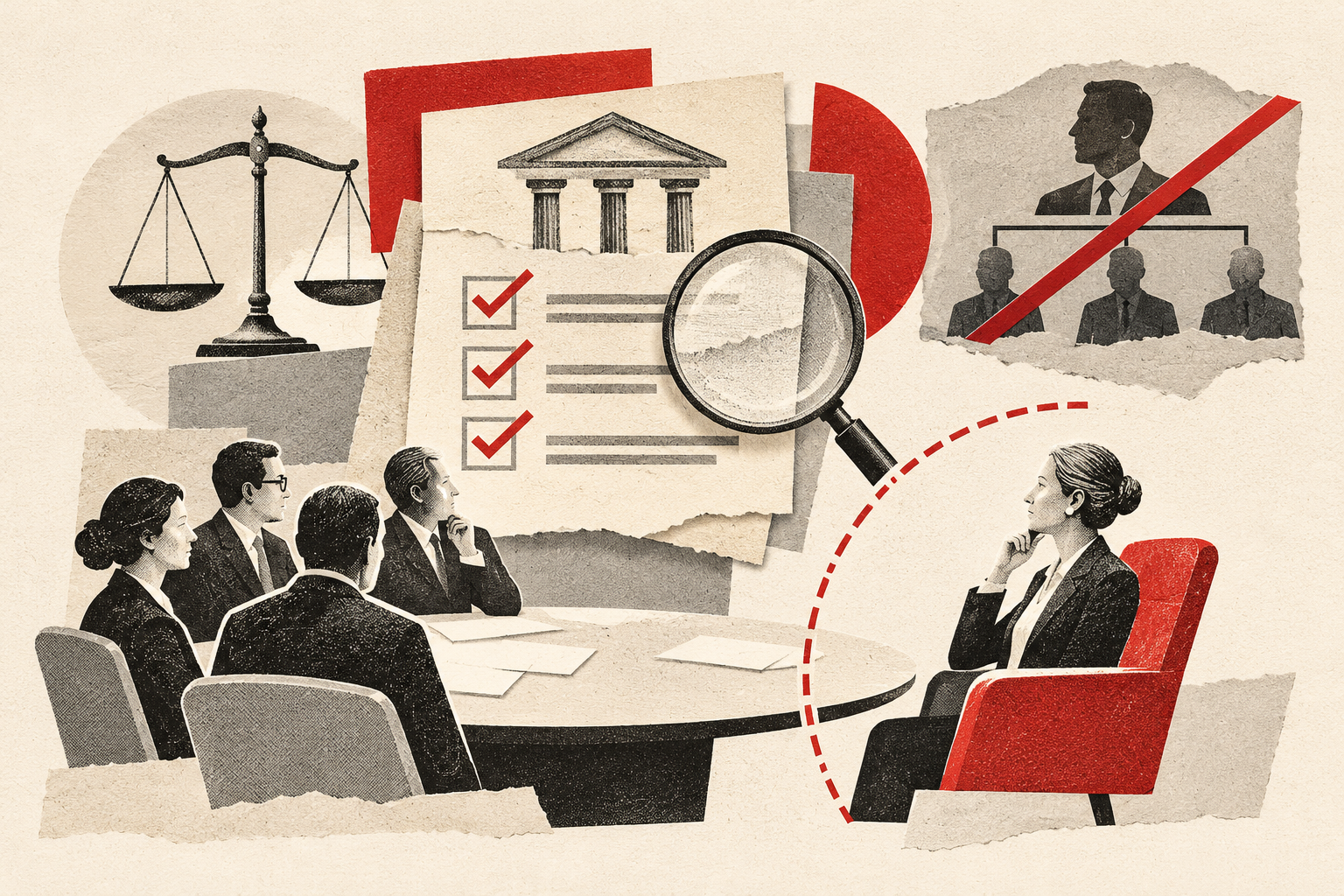
An audit committee is a board-level group that oversees financial reporting, external auditors, and important internal controls. Its members challenge accounting judgments, monitor audit independence, and track unresolved weaknesses rather than prepare accounts themselves. Effective oversight depends on independent judgment, timely evidence, direct access to auditors, and documented action when reporting risks increase.
The practical question is not whether a company has an audit committee on its organizational chart. It is whether directors can identify a reporting problem early, ask sufficiently specific questions, and ensure that management corrects its causes. A credible committee creates a clear line between preparing the numbers and scrutinizing the process that produced them.
What Is an Audit Committee?
An audit committee is usually a committee of a company’s board of directors. Its central purpose is to oversee the integrity of published financial statements and the processes surrounding those statements. Depending on the jurisdiction, listing rules, and board charter, its remit may include external audit appointments, internal audit, financial controls, whistleblowing arrangements, and selected compliance risks.
The function of an audit committee is supervisory. Finance executives prepare the accounts and maintain the accounting records. External auditors examine evidence and express an opinion within the scope of their engagement. Directors challenge both the judgments and the quality of the supporting process. These responsibilities complement one another but are not interchangeable.
For U.S. listed issuers covered by SEC Exchange Act Rule 10A-3, the committee is directly responsible for appointing, compensating, retaining, and overseeing the independent auditor. The auditor reports directly to the committee. The rule also addresses independence, accounting-related complaints, adviser authority, and appropriate funding. Different regimes may impose additional or different requirements.
Audit Committee Responsibilities: Who Owns Which Decision?
The role of an audit committee becomes clearer when responsibilities are separated. The committee should neither duplicate the accounting department nor turn every potential control concern into a board-level accounting task.
| Participant | Primary responsibility | Evidence the committee should expect |
|---|---|---|
| Management and CFO | Prepare accounts, select and apply accounting policies, operate controls | Financial statements, reconciliations, estimates and corrective plans |
| External auditor | Perform the independent audit and communicate significant findings | Audit plan, key judgments, differences, independence disclosures |
| Internal audit | Provide risk-based assurance on governance, controls and operations | Findings, testing results, owners, deadlines and retest evidence |
| Audit committee | Challenge, oversee, escalate and monitor resolution | Minutes, decisions, challenge logs and evidence of completed remediation |
| Full board | Exercise overall governance and make reserved strategic decisions | Committee reports and material matters requiring board action |
A central distinction is the difference between receiving a report and exercising oversight. Merely acknowledging a list of control gaps means that a director has received information. By asking which financial assertions are exposed, whether the gap is material, and when an independent retest will occur, a director starts to exercise oversight.
Audit Committee Members, Independence and the Charter
Audit committee members need sufficient knowledge to understand how financial results can be misstated. That does not require every director to be a professional accountant, but the committee collectively needs the confidence to challenge revenue cutoffs, impairment assumptions, control testing, and audit scope.
For covered U.S. listed companies, specific independence rules apply. Exchange standards and SEC requirements can also address composition and financial literacy. Other markets use their own codes or legislation. A company should therefore verify the requirements relevant to its listing and legal form rather than assume that a single global checklist is sufficient.
The term independent directors matters because an executive’s commercial relationships, fees, or influence can weaken the willingness to question management. Independence is not simply a description in a biography. It should be tested against relationships, transactions, and incentives, with conflicts revisited as circumstances change.
What should an audit committee charter include?
A practical audit committee charter describes the committee’s remit, membership, reporting lines, authority to obtain information, meeting expectations, and access to advisers. It should specify how concerns reach the board, who approves the annual audit plan, and how directors monitor overdue corrective actions.
For example, a charter can require the CFO to submit an accounting-judgment summary before each reporting meeting. It can also require the committee chair to hold private sessions with the external audit partner and internal audit leader. Those procedures turn broad statements about integrity into repeatable oversight.
How the Committee Reviews Financial Statements
Financial reporting oversight starts before directors receive the final annual report. The committee should understand how transactions flow from contracts and operational systems into the general ledger, accounting estimates, disclosures, and ultimately the published numbers.
Focus on judgments that could materially change the result
A compact reporting dashboard should highlight changes in accounting policies, estimates, unusual transactions, disclosure judgments, and unresolved differences with the external auditor. Materiality helps establish priorities, but it should not be reduced to a single numerical threshold. Small individual adjustments may reveal a recurring process failure or directional management bias.
Revenue accounting provides a useful example. Directors can ask whether reported sales depend on contracts signed after a period end, whether deliveries or performance obligations support recognition, and whether credit notes were issued shortly after reporting. The committee need not rebuild the sales ledger; it should evaluate whether management has persuasive evidence and independent review.
Where timing is contentious, ask the finance team to document its revenue recognition policies alongside a sample of contracts, a cutoff analysis, and the explanation for unusual manual adjustments. The policy statement alone cannot demonstrate that the policy was applied correctly.
Use a challenge log rather than a passive checklist
A challenge log records the question, supporting evidence requested, accountable executive, resolution date, and committee conclusion. Recurring uncertainty should remain visible across meetings. Without this record, a difficult accounting estimate can appear resolved simply because it disappears from the next agenda.
Consider a manufacturer recording a large impairment charge. Directors could request the assumptions supporting future cash flows, the sensitivity of the valuation to sales expectations, and the relationship between forecasts used for accounting and those used for capital expenditure approval. Divergent forecasts need an explanation, not necessarily identical assumptions.
Internal Control Oversight: From Deficiency to Tested Remediation
Internal controls reduce the risk that financial reporting errors or fraud will remain undetected. Examples include independent bank reconciliations, restricted journal-entry access, approval controls for supplier changes, and review of significant management estimates. No control environment provides an absolute guarantee, particularly where collusion or senior-management override is possible.
For an audit committee, a finding should lead to four questions: What could be misstated? How large could the effect be? What prevents or detects the issue today? How will the proposed fix be tested?
| Control weakness | Reporting exposure | Useful follow-up evidence |
|---|---|---|
| One employee creates and pays vendors | Unauthorized or fictitious payments | Permission matrix, exception reports, independent review |
| Manual journals lack secondary approval | Management override and inaccurate balances | Journal population, access logs and approval testing |
| Inventory counts are poorly reconciled | Overstated stock or misstated cost of sales | Count differences, adjustment log, repeat counts |
| Revenue contracts bypass accounting review | Incorrect timing or amount of revenue | Contract sample, cutoff tests, policy exception analysis |
Under PCAOB AS 2201, auditors performing an integrated audit must communicate identified material weaknesses in writing to management and the audit committee before the internal-control audit report is issued. The standard also addresses written communication of significant deficiencies. Crucially, a material weakness concerns a reasonable possibility of a material misstatement not being prevented or detected promptly; a known misstatement does not have to have occurred.
The committee should request evidence that remediation actually operated for a suitable period. Updating a procedure document is a design change, not proof that staff follow it. Evidence might include a later sample of approved entries, exception reports, and independent control retesting.
Escalation also matters. A control problem involving senior-management override deserves a different response from an isolated clerical oversight. Directors should consider independent investigation and advice where the ordinary reporting channel is compromised.
Working With the External Auditor Without Sacrificing Independence
The external auditor provides a separate perspective on the reporting process. The committee should discuss the audit plan, the most judgmental accounts, significant risk changes, and the auditor’s evaluation of management’s accounting choices. Private meetings without management present can make it easier for an auditor to raise sensitive concerns.
PCAOB AS 1301 requires communication of matters such as critical accounting estimates, significant unusual transactions, corrected and uncorrected misstatements, disagreements with management, and significant audit difficulties. These are not merely administrative topics; they reveal where the company relies most heavily on judgment and whether audit evidence was difficult to obtain.
The committee should therefore ask not only whether the auditor plans to issue an unmodified opinion but also which conclusions required the greatest professional judgment. An apparently clean report does not mean that every control is sound or every minor error has been identified.
External-auditor selection should consider competence, independence, capacity, industry experience and the ability to challenge management. The UK Financial Reporting Council’s Audit Committees and the External Audit: Minimum Standard, first issued in May 2023, explicitly emphasizes audit quality rather than price or perceived cultural fit in the selection process. Its current applicability depends on the relevant UK governance framework and listing category.
In the United States, the committee must also oversee relevant accounting complaints and confidential employee submissions under Rule 10A-3. The process should specify who receives concerns, when directors are informed, how evidence is preserved, and how possible retaliation is addressed.
What the PCAOB’s 2025 Inspection Data Actually Tell Committees
External audit oversight is stronger when directors understand regulator findings, but inspection statistics require careful interpretation. In an October 2026 staff report, the PCAOB described inspections conducted in 2025 covering 143 registered audit firms and portions of 780 public-company audits. The aggregate Part I.A deficiency rate among inspected firms was estimated at 23% for 2025, compared with 38% for 2024.
A Part I.A finding concerns the auditor’s failure to obtain sufficient appropriate evidence to support its opinion. It does not automatically mean the audited company published materially misstated financial statements, nor does it mean that 23% of all public-company audits were defective. PCAOB inspections involve selected audit work, and the 2025 figures were described as estimates pending final inspection reports.
The same report estimated the Big Four U.S. deficiency rate at 8% for 2025, down from 20% in 2024. Yet the figures varied substantially among categories of firms, and the PCAOB cautioned against simple explanations for changes over time. The useful committee question is whether its own auditor has recurring findings relevant to the company’s risk areas, not whether a broad industry average guarantees a good audit.
For instance, the committee might ask the audit partner how the firm addressed inspection findings involving internal controls, revenue, or estimates. Directors can also request an explanation of staffing continuity and specialist involvement. This converts regulatory data into a discussion of audit execution, rather than using a headline percentage as a simplistic quality score.
Planning an Effective Audit Committee Meeting
An audit committee meeting works best when the papers distinguish routine updates from matters requiring a decision. A large pack of finance slides does not automatically provide oversight. Directors need a short statement of the issue, the potential reporting impact, alternatives considered, and the action requested.
A practical agenda for one reporting cycle
- Confirm earlier actions. Review overdue remediation items, evidence quality and unresolved escalations.
- Challenge financial reporting. Examine unusual movements, revised estimates, late journal entries and relevant disclosures.
- Hear from the auditors. Discuss audit scope, independence, difficult judgments and unexpected evidence gaps.
- Review control findings. Separate design changes from operating-effectiveness testing and confirm control owners.
- Consider whistleblowing matters. Review significant concerns and whether independent investigation is needed.
- Report to the board. Record decisions, matters requiring board approval, and the date for follow-up.
The exact number of audit committee meetings depends on the company’s obligations and reporting calendar. A committee dealing with a fast acquisition, a financial restatement, or a control failure may need additional sessions rather than relying on its standard timetable.
Illustrative Case: A Revenue Cutoff Problem Before Year-End
Consider a fictional distribution company with annual revenue of $180 million. In December, sales staff record $7 million in invoices for products that remain in the company’s warehouse. Under the relevant contractual terms in this hypothetical, customers do not obtain control of the goods until shipment in January. The accounting team nevertheless includes the invoices in December revenue.
The issue involves 3.9% of annual reported sales, calculated as $7 million divided by $180 million. That percentage alone does not settle whether the misstatement is material; earnings, margins, contract terms, disclosures and qualitative factors also matter. The scenario is an illustrative exercise, not a report about a real company.
A weak committee might accept management’s statement that the invoices will reverse automatically next month. A stronger committee asks for a contract sample, shipment evidence, a list of affected entries, and a determination of the proper reporting period. It also asks why the cutoff control failed and whether other sales teams followed the same procedure.
Suppose management corrects the entries before issuing the statements. The financial adjustment addresses the immediate accounting error. However, the underlying control issue may remain. The committee should therefore request a revised shipping-data reconciliation, approval ownership, and a follow-up test of contracts near the next period end.
The external auditor should receive the relevant information and consider its audit implications. Depending on circumstances, directors may also examine incentives linked to annual sales targets. The main lesson is that correcting the balance does not by itself prove that the reporting process is reliable.
Beyond the Ledger: Operational Risks That Affect Reporting
Audit committee responsibilities often intersect with broader risk governance, but committees should avoid absorbing every operational issue. The full board or another committee may oversee strategic and operational risks, while the audit committee focuses on their effect on controls, accounting estimates and disclosures.
Supply disruption offers an example. A failed supplier may cause inventory write-downs, late customer deliveries, impaired assets or additional contractual liabilities. Directors can evaluate whether management’s financial reporting reflects these consequences while a separate operational team manages supplier recovery.
This boundary becomes clearer when supply chain risk oversight is connected to specific reporting questions. Are inventory carrying values supportable? Are material commitments disclosed? Have disruption assumptions changed the forecasts used in impairment models? The audit committee should track the financial implications without replacing procurement management.
Common Audit Committee Failures and Practical Fixes
| Failure mode | Why it matters | Practical improvement |
|---|---|---|
| Meeting packs arrive too late | Directors cannot evaluate complex estimates | Send decision papers early and highlight unresolved judgments |
| Management controls the entire agenda | Uncomfortable findings can disappear | Schedule direct sessions with internal and external auditors |
| Control findings are marked complete too soon | Paper fixes are mistaken for effective controls | Require independent retesting and supporting samples |
| All findings receive the same attention | Material issues compete with routine observations | Prioritize exposure, likelihood, remediation and escalation |
| The committee relies only on the audit opinion | Significant reporting process weaknesses may remain | Ask about estimates, uncorrected differences and control evidence |
Good oversight is not measured by the number of questions asked or the thickness of the meeting pack. It is visible when questions lead to better evidence, improved controls, timely decisions, and measurable closure of significant matters. Where directors lack the expertise to evaluate a specialized accounting issue, an independent adviser may be more useful than an unsupported committee conclusion.
FAQ: Audit Committee Role and Responsibilities
What is the main role of an audit committee?
The main role is to oversee financial reporting integrity, external audit arrangements and relevant internal control matters on behalf of the board. The committee reviews evidence and challenges management’s judgments. It does not prepare the financial statements or replace the independent auditor.
Who can be an audit committee member?
Members are usually directors selected under applicable governance and listing rules. Many listed-company regimes impose independence and financial competence requirements. The precise rules vary by jurisdiction, so companies should verify eligibility against their applicable exchange standards and local laws.
Does an audit committee perform the financial audit?
No. External auditors perform the independent audit, while management prepares accounting records and statements. The committee supervises the auditor relationship, discusses significant audit findings and monitors whether management addresses reporting or control weaknesses identified during the process.
What does an audit committee charter do?
An audit committee charter defines the group’s responsibilities, authority, membership expectations and reporting procedures. A practical charter also explains access to advisers, communication with auditors, treatment of complaints and escalation to the board. Requirements vary by governance framework.
How often should an audit committee meet?
Meeting frequency should reflect the company’s reporting timetable, complexity and regulatory requirements. Committees commonly hold scheduled reporting-cycle meetings, with additional sessions for significant transactions, control issues or audit disagreements. Effective follow-up between meetings matters as much as the calendar itself.
Can an audit committee guarantee accurate financial statements?
No. Oversight can improve the reliability of reporting, but estimates, fraud, management override and practical limitations mean that no committee can provide an absolute guarantee. Management remains responsible for the accounts, while auditors provide assurance within the scope and standards of their engagement.
Key Takeaways
An effective audit committee is a structured channel for independent challenge. The committee needs a clear charter, appropriately qualified members, access to auditors, and a reliable way to track reporting judgments and control remediation. It should ask for proof that controls work, not just plans to improve them.
The strongest oversight connects accounting decisions to underlying transactions, tests whether explanations are supported by evidence, and documents action when risks remain unresolved. For boards, investors and finance leaders, that practical discipline matters more than a generic statement that the committee protects financial reporting quality.